Showing posts with label Greece. Show all posts

Saturday, April 21, 2012

Fulbright (Thessaloniki) Day 3!


I was really looking forward to our last “official” day in Greece. We were to go see the historical site of Vergina. There is a lot of controversy at this site. They found a tomb there that they said is Phillip II and his grandson Aleksandar (not the great, but his son). The controversy surround it involves Macedonia. The 16 pointed sun was found at this site (as well as others) but because Phillip 2 is buried here, Greece claims that no one else can use this sun. And promptly yelled at MK for doing so on their flag. To this day, people still use the old flag when trying to make a political statement. So I was curious to see what all the fuss was about.

The city of Aigai, the ancient first capital of the Kingdom of Macedonia, was discovered in the 19th century near Vergina, in northern Greece. The most important remains are the monumental palace, lavishly decorated with mosaics and painted stuccoes, and the burial ground with more than 300 tumuli, some of which date from the 11th century B.C. One of the royal tombs in the Great Tumulus is identified as that of Philip II, who conquered all the Greek cities, paving the way for his son Alexander and the expansion of the Hellenistic world. Or for the long description: UNESCO Site

We hopped on the bus (a bit late, of course) and took off to the monastery that the guide had recommended. Beautiful countryside. It also let me mark where the turn off to Skopje is so I could find it the next day when we were going home. Well, we saw some beautiful beautiful countryside, even though we were going the wrong way! We turned the wrong way and went out about 30 minutes the wrong way. We pulled into this monestary (turned out to be a nunnery), and these nuns looked at the tour bus like we were crazy! We were so at the wrong place. The little drive up to this place was amazingly scary- so twisty turny and step and no guard rails! But the driver was amazing and soon we were on the right way to the right monastery where we were supposed to have a guide. We did arrive there and it was breathtaking. See:


We heard about how this was where this “saint” had gone and had a vision or something like that. It was a bit difficult to hear/understand, because it was being translated and that wasn’t very good either.  After a tour with the priest and our guide, in the rain we hopped back on the bus to go to Vergina. At this point we were about 1-2 hours off of our schedule. (and already behind on lunch!) We made it there, but only the tombs were open due to reconstruction. I was interested to see how the tour guide explained the history since it is so controversial. She failed. She basically spouted the party line that Macedonia is only Greek and no one else can claim anything related to the kingdom of Ancient Macedonia. (which is a little harsh due to this map, just saying.)


I would tune in to her talking for a bit and then tune out. She even at one point said “Since 75% of the gravestones are in Greek, that means that everyone was ethnically Greek.” I’ll just let that sink in a bit. If most of the population is one ethnicity, that means, according to her, that no other ethnicity matters or deserves recognition. Like WOAH! That’s when she lost me the first time. You know it’s bad when the girl who is studying the classics tells you she is incorrect in her history. But regardless, it was interesting to see the sights and the possible bones of Phillip 2.

After this we went on a 45 minute drive to lunch. Lunch was at what is supposed to be a high class ski resort that is well known for its trout (or something like that), but at this point we were all just willing to stop and get something along the way we were sooo hungry! Lunch was ok. There was way too much oil in the veggie plate, and a lot of the appetizers were just not to m liking (or had too much oil). But the people who got the meat plate seemed to really enjoy it.

Then it was back on the bus to Thessaloniki. We had a bit of down time before we were to have dinner again (about 2 hours or so total!). So a few of us just wandered around for a bit before eating dinner. We even went a picked up a few bottles of wine to split over our dinner tonight. After dinner, we went out to a pub to just hang out some more. I went home early because Daniel and I were going to go to the Museum for the Macedonian struggle the next morning, so I didn’t want to stay up too late.

See you around the globe!

P.S- GROUP SHOT!!


Friday, April 20, 2012

Fulbright Seminar (Thessaloniki) Day 2


We started off the next day (after breakfast and informal social time) with a bus ride to the Museum of Byzantium Culture. That is where we were doing one more presentation and another lecture.

The first session there, was another group of student presentations. Including Mine!


Cassidy Henry, Studying A Community that Doesn’t Exist: (Do you know how hard it is to summarize your own presentation? Really difficult!) There are definitely challenges to working as an NGO in MK. The climate is realtively harsh- with political party connects, money laundering accusations, and a real lack of money coming in to help fund projects. In MK, there are two official documents governing the government and NGO cooperation: Strategy for Cooperation with Civil Society and the Law of Associations and Foundations. The Strategy was very overarching and too ambitious, so most of it was not accomplished when attempted. However, the Law on Associations and Foundations, implemented many great changes (allowing NGOs to make money to cover costs, and complete fundraising activities to even allowing organizations some tax havens). There is some research out there saying that NGOs communicate great and work well together, but none of the NGOs I have ever talked to had good cooperation with another NGO. Most never even really communicate with a different NGO, much less the government. There is also infighting for the same small pool of resources. Although there is some hope for the future- many organizations would like better cooperation with each other and the government and they are open to working together.

Jennifer Zenovich, Defining Feminism Amongst Women in Montenegro in Academia: It is difficult to define feminism, because so much of the definition is relevant to the context. Jennifer prefers bell hook’s definition (this might not be the exact quote, but it is close enough for horseshoes or hand grenades) “Feminism is a movement to end sexism, sexist exploitation, and oppression.” There is an element of taboo in mentioning feminism in Montenegro, with a subtext of being against the state. They rejected feminism (in the past) as being Western/bourgeoisie. Through the transition, there is a possibility for a re-working of this concept, but it is slow going. However, to ensure a democratic transition, women and feminism could really help. At the university, there are now two courses about feminism: ‘Feminist Literature’ and ‘Gender Psychology.’ One of these classes is taught by a younger professor and the other is taught by an older professor.  The younger professor is for a more western literacy movement and was raised after communism. The older professor claims to not be feminist, but for human rights. She said that she isn’t for the violent, radical events that feminists support. But a question that Jennifer is looking at: can it be called feminism if it is only viewed through a western ideology?

Adam Julian, Hip-hop and  minority language Revitalization: The Case of Gagauzian and Vitali Manjul: The Gagauzian language is considered a dying and endangered language. It is forecasted that within two generations, the language will be dead. Currently, only the over 50 crowd even speak it. The Gaguaz language is a Turkish language, although they currently live in Moldova (which speaks Romanian and Moldovan/Russian). They are separated from the Turkish religion words, although the Turkish influence is being absorbed into the language. Some of the grammatical structures are changing. Unlike other minority languages, Gagauz lacks a sphere of influence. Russian is everywhere- in schools, at the market, at home, in political life. Another problem they are facing is that there is not a unified script for Gagauz. There are some textbooks, but they are almost 20 years old and there is no changes for the Turkish words in them. Students are supposed to learn all three languages, but they can’t. Adam couldn’t even learn the language there! A new sphere that this one artist is doing is hip=hop using the Gagauz language. But he is mostly considered a laughing stock. Adam put together a video that I would like to link you about this rapper:


Karla Hoppman Buru, Exploring Cross-Cultural Social Work and Public Health Collaborations in the Jiu Valley: There are 7 smaller communities in the region. All organizations participating in the research had to have had international sponsors and volunteers. There were different reactions and support levels within the region. She is still in the research phrase, and talked mostly about how she is conducting her research. She is working closely with locals to complete the interviews. She interviews the international organizations and her local contact interviews the Romanians so that they aren’t inclined to make the picture more rosy than it is. She will be putting on a training in May to help them get on the same communication level.  (And I’ve been invited to observe it! I am really thinking about going, now if only I knew how to get there!)

After our presentation, we had the Deputy Mayor for Finance & Development speak and introduce the 2nd keynote speaker. Mr. Hasdai Capon, the Deputy Mayor basically just welcomed us to the city and said I hope you have a good time!  After her spoke, Mr. Dimitris Keridis, an Associate Professor of International Politics at a local university, spoke. Mr. Keridis also runs the Navarino Network, which promotes innovation and extroversion in public life while addressing the challenges of my generation. They also run these amazingly cool looking summer schools, (and although the deadline has passed, feel free to look at them). He then proceeded to talk about the economic crisis. We had been promised a talk about ethnicities that I was really looking forward to, but to no avail. Economics instead. If you know me at all, you know that econ is just not my thing. (it probably has to do with the math part of it and math and I don’t get along). The main take away that I got from his lecture, is probably not the one he wanted me to get. He kept stressing how Greece is not a European country but a more Eastern country. I had never heard that dialog before. Almost everything I had heard is how Europeanized Greece is. And how much it deserves to be in the EU because it is an European country. He did mention how the current crisis can’t just be blamed on economic means, but it also has to be blamed on politics. Institutional settings can also be blamed for part of the problems. Such as Greece not taking the Euro seriously and borrowing without limits. The global financial system didn’t account for difference between Germany and Greece. He did use a metaphor that was enlightening. The EU is like a bike, you either go forward or fall over.

After his talk, we stood around waiting for a group picture. It took forever for him to get srt up, because the lightening was so bad! However, we then had a tour of the museum. Now, while I like museums. When Every. Little. Thing. Is. Very. Very. Important. And. You. Must. See. This. One. Last. Thing. About 40 times, you get tired of hearing the same thing over and over and over. Now, don’t get me wrong this guide was super friendly and she was very passionate about her stuff, but she kept repeating herself over and over and over again. Like we were supposed to quickly walk through the museum and then eat lunch, but the museum tour took about an hour because she kept wanting to point out even more stuff for us to look at. But they rewarded us with delicious Greek food at the end. All fried or baked or unhealthy for you (except for the small mostly bread mozzarella and tomato sandwiches), but the food was so good! They had this potato baked in bread thing, yum!

We hopped on a bus for what was supposed to be a city bus tour, but involved more walking and talking than actual bus touring. We stopped off at some churches whose names I can’t remember, but they were super pretty. One had been converted into a mosque during ottoman times, and then is recreating into a church now. We went up to the top of the hill and overlooked the city. She seemed to be very sensitive to her history. (Turns out she had a high fever and still came out and shared with us!) She kept repeating how everything was closed after 3 pm. To the point that we really understood that things were closed after 3pm and we wouldn’t get to see as much.  Oh and did you know that there is just one more thing, that you should really see, because it is very important? No? Well…..


After a bit of coffee time back at the hotel, we started our final panel.  In this panel there were only three presenters, I think one girl wasn’t able to make it to the conference.


Athan Geolas, Three Legged Chairs and Capable Cities: Athan is in Athens studying architecture.  He wanted to see if there was any correlation between space and usage. He mostly showed us his drawings, but he did share a few assumptions that architects have: (1) Building change peoples lives, if they don’t then they are useless. (2) Faith in building the right building right now. Some spaces they have seen as centered around a water source or private space (where everything is enclosed). His work is best seen by looking at it, so I suggest you go look at his blog. Here is an example:


Lisa Owen, Familial Roles in Contemporary Croatian Cinema: The film industry is developing in Croatia, they produce about 7-10 films every year. Usually the war features prominently in the films that are about the war specifically with family drama. There are important parent and son relationships. The male protagonist is often the main character. The strongest bond is between the mother and son in any movies. She suggests that it is due to the privileged space of mom. The “Wall of Love” or the fierce mother, they were recalled from the Yugoslav army to serve in the homeland war. She provided two examples of movies where the mother is fierce (and kid of scary).

Stefana Simic, Banja: Thermal Spa Designs: There is rich potential in the banja for health tourism and sustainable development. A bit of history- Serbia lies on 7 different tectonic areas, which over time created thermal springs. Banjas are hybrid thermal springs and hospitals. Every banja has a clinic or special hospital. If you need rehab you will often go here. Recent political restructuring has led to a change in the definition of a spa. The reconstruction or construction of banjas is not included in the current plan, and many are in total disrepair. They are even viewed as financial burdens on the local people; thus they are shut down and abandoned. Health tourism is a $1 million industry, and it could be focused sustainably. She's an amazing artist by the way- her work was just wow. She showed some paintings and designs and it was just wow! Here is an example of it:


Then we got our certificate. They love certificates in this region for some reason. Apparently it is seen as a attendance sheet, so you get one even for just participating in a conference. I find it a bit odd, but…Apparently in some cultures they even keep binders of their certificates of completion.  We had to take our picture with the certificates and then we were able to go across the street (to the hotel we are staying at) for dinner! After dinner, we went out for a little walk as we were waiting for others to return so we could go out with them, but they never returned! So off to bed for the long next day!

See you around the globe!

Thursday, April 19, 2012

Thessaolniki Conference: Day 1

Our first “real day” of the Fulbright Enrichment Seminar, started with a yummy fulfilling breakfast! I was, of course, one of the first people down there from our group. But slowly the others started trickling down. (As a note, these early wake ups have seriously messed up my sleeping schedule! I am still waking up at about 7:30-8 am, but am staying up later than when I did at the conferences…) This was also part of our “informal social time” built into the conference schedule. (yes, they tagged breakfast as social time, like we weren’t already going to do that.) After social time, we headed across the street to the sister hotel of where we were staying and got ready for the conference to officially open.
The executive director of the Fulbright commission in Greece was there to open the conference up! She was followed by the Consulate General in Thessaloniki, Catherine Kay (I had already talked to her and looked forward to meeting her in person. Before we headed down there we received an email from some one at the Fulbright Commission [who shall remain nameless] asking use to use FYROM instead of Republic of Macedonia or even Macedonia while giving our presentations for the sensibilities of those who were in the audience of Greek origin. We were outraged to say the least. It is repeated over and over and over that our research is ours alone and doesn’t represent the official US government views and how we are independent researchers. But here we were being asked to change our views and our research. We were not cool with this (there were three of us asked to do this). I emailed our embassy here asking them how did they diplomatically deal with this issue so I could try to find a diplomatic response. And ended up involving our embassy, the consulate in Thessaloniki, the IIE office in DC, and the embassy in Albania. In the end, it was suggested by Catherine that we just use Macedonia and not mention the dispute in public. Or at least in our presentations.) She was quickly followed by George Frowick, the Cultural Attaché at the US Embassy in Athens. They then answered a few questions that we put to them, before having to run away to their next engagement.

They showed us a video of Fulbright Greece since 1948. It was highlighting the different accomplishments and programs that the Fulbright Commission in Greece has done since the beginning of the Fulbright program. They are the 2nd longest program in the world and the longest in Europe. (According to Wikipedia, China was the first program ever.) I tried to find the video for you, but to no avail, it is not online anywhere! After a short break, we had our first student presentations. Like the presentations in Ohrid, I think these deserve a bit about each one, so you get that now! Even if you don’t like it!  :)

The first presentation was by Dr. Leon Nar, who is a professor of Greek Literature in Thessaloniki. It was supposed to be on “Thessaloniki, the Future of the Past 1912-2012,” but it was more on the random history of the city. He jumped all over the place from place to place in the city to different times. So forgive me if these notes are a bit convoluted. Apparently on August 5, 1917, there was a 30 hour fire that destroyed the city, especially in the Jewish community area.  Greece also participated in the “exchange of populations” with the Ottoman Empire.  The Muslim populations “left” Greece and moved to Turkey while the Greeks “left” Turkey and went to Greece. However, many of these people didn’t speak any other language than the one that they left. Then WW2 happened, and 50 thousand were taken and only 2,000 returned. This obviously decimated the Jewish Community of Thessaloniki. Also to add insult to injury, Jewish gravestones were used to pave the roads and build houses while Greece was occupied. Throughout the years, Thessaloniki was neither a province or a capital. It occupied a weird position of having existed longer than Athens, but not being the capital. (About this time I got lost in his monotone reading of 20 some odd pages without stopping and had trouble paying attention. ) He did mention something about former Yugoslav people moving towards Greece after 1991. I wanted to ask him about how Greece doesn’t recognize minorities, but our questions were shushed because he had to go to work and lecture.

Then we had lunch upstairs at the hotel. It was a salad, meat option or pea stew, and dessert. It was interesting to talk to people more and get a bit more of a feeling of what others are doing. We also got to talk with a lady who is a fellow completing research for her next book.

Then we had our first student presentations.  They were “kind of” grouped into related topics. But not really. The first group had four people presenting.


Gerald “Bill” Gugerty, The Sexy Microfinance Industry: Dispelling Myths to Refocus on Poverty”: In the 1970’s the industry became “sexy,” and has even been called this in academic publications apparently. 2005 was actually called the Year of Microfinance. But there are a few negatives: the over promotion of sustainability , anti-private market moves, and the lack of concern for the environment. A major problem is that the movement could be self-sustaining, it collects enough interest to pay bills and fund new ideas. Some microfinance agencies have become self-sustainable, but they are still being funded by the major aid agencies. But in becoming sustainable, many have a mission drift with no longer focusing on alleviating poverty. These “sustainable” ones are funding bigger loans that are still not fundable by normal means, but they are too big to be real community changers, and many people are left out of the loan process.  If they are sustainable, then private investors can choose to invest in it rather than have aid funds.  Another problem is the environment. It is often overlooked or ignored in the progress of development. This is really troubling because poor people rely disproportionately on the land they work for their survival. If their loans help them destroy the land, then they are not able to continue providing for themselves. We need to refocus on the poor and poverty alleviation as the main goal.

Anja Vojvodic, Women in Politics: Progress and Impact in the Serbian Context: In Serbia, there are no legal form of discrimination against women.  They make up 22% of the national assembly. Further,  2 of 17 ministers are female. Out of 150 mayors, 10 are women. But out of the 23 city mayors, only 1 is female. The Ministry of Social and Labor Policy recently did a survey and found that 43 % of Serbians believe that abortion should only be legal for health reasons. When Serbia wrote the National Strategy for Gender Promotion/Equality law, they wrote it so that every 3rd person on the party lists should be the under-represented gender. (Not specifically female or male, so in case it changes down the road.) Women usually run to help change the situation in Serbia

Richelle Bernazzoli, Keeping the State Viable: The security-Identity-Integration Triangle in ‘Euro-Atlantic’ Croatia: The security/identity nexus is where identity is fluid and context based, with geographies of inside/outside. Security is about guarding real and imagined boundaries. When we look at NGOs, state sovereignty might be strengthened by EU/NATO structures. A representative of the Meshihat Islamic Community, stated that they were no longer a minority party because they were now part of the larger international community. There is also the idea that Croatia has fought harder for western democracy than any other state and deserves to be a part of the EU with in Croatia. When looking at integration, people look towards identities that are beyond their national ones.

Cody Brown, Risky Endeavors: He is looking at those who participated in the Croatian Homeland War (1991-95). Participation was largely voluntary, and there wasn’t a draft. He is looking at why they decided to join. Literature states that it was greed (material gain) or grievance (oppression by the Serbs) that led people to join. However, his research doesn’t agree with these findings. If it was material interest, the soldiers didn’t see anything for the first 6-8 months. Of the 14 people included in this presentation, 10 of them had grievances: 2 had partisan family deaths, 4 had been arrested by the communists, 2 faced harassment, 10 were NDH supporters (the wrong side of the war in WW2). But given that killing was indiscriminate (not military targets), it represented a threat to all groups not just a specific group. Regardless of the attitudes to the other group (ie Serbs) it might be riskier to NOT participate than to participate. When asked why they joined at the time that they did, those he has interviewed replied: fighting was all around-7, Croats would be slaves if we didn’t fight-8, couldn’t watch it go on with out me-6, wanted revenge-1, independence-8.

After a short coffee break we went back for more student presentations. There were also four people in this panel!


Nicholas Sveholm, A Mighty, Crumbling Fortress: Diaspora, Romania’s German Speakers and the Volksgemeinschaft: After WW1, the Germans discovered that they had lost “brothers” in other areas, after they lost part of their territory. The ironic part, is that Romania was never part of an Unified Germany. Yet, diaspora organizations were created to aid those who were separated from Germany. The aid organizations used these areas as case studies to see what is really “German.” Mostly the aid organizations helped on a cultural level with schools and churches. These people rarely defined the diaspora, but the people who did define it were based in religion. There is some language difference between the two groups (mainland Germany and the Romanian enclave). The Germans in Romanian applied to help from the Germans in Germany when taking tests in Romanian, because they didn’t know that language very well.

Daniel Pout, Negotiating Identity: States, Migrants, and the Instability of Proper Names: (This one isn’t as long, because he was mostly telling stories about the people he interviewed and I didn’t wrote those down.) Identity is never just about the self, but it is also about the community. The state authorities (at borders) yield a lot of power in deciding who you are. But how do you convince others that you are who you say you are? Borders aren’t just at the state level anymore. When 6,000 ethnic Macedonians “left” Greece and went to Bulgraia, most of them then moved on to Macedonia because they felt like that was a better homeland. Even though the Greeks considered them Bulgarians and they were encouraged to take Bulgarian citizenship.

Ellen Rhudy, Identities Formed in Opposition: Albanian National Identity in Albania, Macedonia and Kosova: (Ellen lived in Debar, MK as a Peace Corps for a few years, which is where many of her stories come from.) In Debar many people strongly identified with their Albanian roots even more strongly than in Albania. They often would recognize the Greater Albania idea. They even named some kids after towns in Albania. While they are Muslims, they practice a slightly different way than those in Albania proper. The Macedonian-Albanians are working within the legal system of MK, but those in Kosova succeed from their state. Albania was created in the 1930s, but it wasn’t Albania deciding where they borders were- the Great Powers were. While there is a strong regional identity, they unit over other factors (such as religion). The “oppressed Albania” idea also helps to unite the Albanians. Some of the differences that can be observed between Albanian proper and the Albanians in the other countries can be attributed to the Former Yugoslav times when they were separated.

Andy Halterman, Exploring the success of VetÑ‘vendosje: The VetÑ‘vendosje are a left wing Albanian nationalist organization founded in 2004 (after the UN administration). They successfully use Albanian imagery in their advertisements. They never use the Kosovo flag. They have had political meetings in virtually every village. They were a social movement until the most recent election when they joined the national legislature. Now they balance political power  and street activities. They appeal to the idea that independence is an ongoing process. He is seeing how they succeed and why. And how they are able to negotiate the political party vs. grassroots idea.

After the presentations we went to the Consulate for dinner. Dinner was basically the exact same thing as the day before. Did I mention how delicious those potatoes were? But we got to meet and talk with Catherine Kay (the Consulate General mentioned earlier).  It was nice to just talk to people again and relax. While I wasn’t allowed to get a picture that day of the consulate, I was the next day. (but got yelled at). Like seriously people. If I was a terrorist or something, do you really think that a random picture of an elevator is going to do anything for me? But I digress.

After dinner, we went and had drinks by the White Tower. More chit chatting and hanging out with Americans = more fun! Greece even sells alcohol after 7 pm! (shocker, right?!?!?) Then sleep for another early day!

See you around the world!

Thursday, October 20, 2011

Greece Day Three

We started off by walking up towards where Daniel used to live for his LDS mission. And then we got “bugasa” which is phyllo dough and cream or cheese baked with lots of butter! And juice.


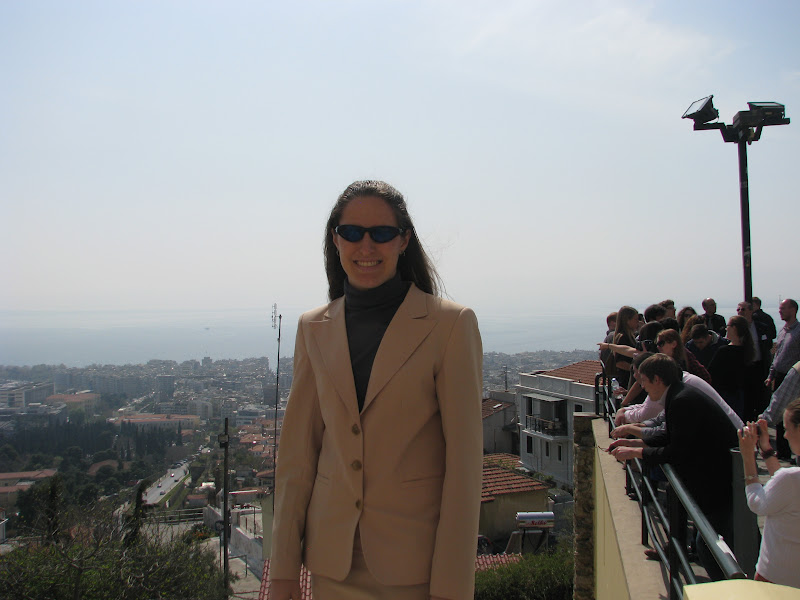
Then wandering around up on the mountain and enjoying the (sarcasm) oh so nice day (once again wet and cold). [It did later get sunny and comfy, but for some reason my sun glasses had not made it into my purse that day.] Many pictures came from this:


We found shoes for Eliana.


Caught a bus downtown and went to the White Tower. A plaque says that it was white washed by a convict as a condition for his release. And Thess was “liberated” from its rulers in 1912. Of the same agreement that tore up what is now the Republic of Macedonia and helped form the resentment that led to nationalism and establishment of the Macedonian state. But liberated is a fine word for a victor.


After visiting the Tower, we wandered over to see the Alexander of Macedon statue, but it was blocked by construction. We went to lunch at this little local restaurant and I had pasta. It was so-so. Then we caught a city cultural bus around the city. It took about one hour and only cost two Euros! I highly recommend this. But you will want to sit next to a window that opens otherwise it is very “prettily” covered by a design advertising that it is the city cultural bus.

After I took this, Aidan went "I didn't like that." Aww..


Afterwards we went back to the hotel (after stopping to get some souvenirs).  Checked to see if we could get a rental car instead of taking the bus. It turns out that you literally can’t rent a car to take out of Greece and especially NOT to Macedonia. So we decided to go catch the bus, but after stopping to get some food (Cheetos and Oreos! Which they don’t have in Macedonia- oh yea and some normal food as well). When we got there, Anje made the mistake of calling the Republic of Macedonia “Macedonia” to Aidan (who is 4 by the way) in front of the saleslady, who promptly responded “you are in Macedonia!” To which Anjie said “Oh yea, I keep forgetting!”

Then it was about a 5 hour bus ride back. Well, it was more like a 4 hour bus ride with an hour at the border to go shop-shopping  in the duty free shops. Daniel, Anje and I had some really cool conversations on the bus ride that I wish that I could reply- if only I could remember exactly what we talked about! When we got back to Skopje we caught a taxi to the center where their car was. And I walked home because I was sick of being in cars and wanted some fresh air.  Then sleep, precious precious sleep.

See you around the globe!

Greece Day Two: On the Road Again

We all were to meet downstairs at 7am to leave (supposedly at 7am, but het, it IS the Balkans).

Had a yummy breakfast of bread with butter and jam, hard boiled egg, and cereal. And some really disgusting juice type drink that I finished because it was probably good for me. And hot chocolate. (oh yea!) (And a bread and cheese sandwich for later. If you had hard up for money/don’t know when you will be stopping, hotel breakfasts are usually great for getting a sandwich out of it. Just fold it up in a little napkin and stuff it in your purse of bag. Voila! Lunch as well!) Then at about 7:30-8am we all got loaded up in the bus, backed out into the street, started to leave and then stopped.

No joke.

And then we waited. For two hours with no one on the bus really knowing what was going on. Daniel told us that someone had told him that the organizer was asking the town hall how to fill out the paper work for the next town. We didn’t think this made sense, but it turns out that he was actually applying for a few people in this small town. It would have been nice to know about that so we could have, I don’t know slept in a bit, or let the kids play on the playground and use up all of their energy.

Then we headed off to Serras (sp?) which was about a 30 minute drive away through the countryside of Greece. Mostly on highways, but still pretty.


We were in Serras for about 30 minutes since apparently the district seat had changed to a newer smaller city to apply for your birth certificates. It was just enough for us to want to get out, but be unsure about getting out so the kids got anxious and we were already starting to guess what today would be like-waiting and unknown. I grabbed a quick picture of the town to prove I had been there.

Then it was off to Nea Zichni, itty bity small town where the government seat was. The amazing thing was that the bus fit through all of these streets and was able to back up and effectively turn around and move! I am not sure if the pictures show the streets enough, but it was tiny! We were able to get off the bus and wander around for a bit. Although it was cold and wet and raining.


"Pamela Anderson Baywatch" on the back of a pick-up with dog crates in back. I felt like I was back at home for a second!

A bunch of people bought oil, I guess it was cheaper here?

When Daniel got back (he had gone with them to make their applications) he told us what had happened. When they made it in to find the right office, they told them they wanted to receive their birth certificates. The cops started getting nasty at this point. “Where were you born? Why are you speaking that Pakistani language? Where were your parents born? Why did you leave? How do you spell your name again?” When they finally found the brothers names in the book, next to their names it had “These people are not Greek.” The police then refused to give them the birth certificate. Which is weird because apparently Greece has if you are born here you are Greek. But they wouldn’t do it-said if they are not Greek then they can’t get passports. At this point, Daniel’s group leader argued that we are just trying to get a birth certificate NOT a passport. (given they were going to try to get a passport later, but that is a different story that didn’t occur.) When they looked for the other lady they could not find her listed on the register. (She even tried to show her Macedonian passport showing she was born in Greece in this village on this day (but they wouldn’t accept it.) She does not know if the police could not find it or if they just wouldn’t work with them on the spelling of her name because she was trying to put it in Greek and she wasn’t exactly sure of how it was spelled in Greek.

After another two or so hours, we took off again for another tiny village. Where we again filled out paperwork for about an hour. It was still pouring at this point so we didn’t really get out. Except for when we went inside to go to the bathroom. The best part- seeing the beer bottle on the windowsill of the police station. They did pause for a group picture:

Govt building with beer bottle.
Then we went to one last little village. One of the guys said that when he had come to this village with his mother awhile back there were only three houses. And now there was a whole village. It turned out that they were no longer going to Drama (yup said like the play thing) but instead heading straight back to Skopje. So Daniel said lets get off here and catch a taxi or something to Drama. We were only 10 km away, so not too bad. Turns out there is a bus leaving in about 15 minutes. So off we hopped with all of our luggage and waited at the bus stop:
No joke. The bus sstop is a park bench. The timetable is attached to the wall of a nearby building.
And ate some cock (no I have no idea if this is spelled correctly since I don’t speak Greek, but this is what Daniel called it. I know weird.) It is custand between two cakes with a chocolate honey topping. Yummy, but a bit too sweet.

 
Then we caught a bus to Drama and then a bus to Thessaloniki from there. The bus to Thess took about 2 hours, but I caught some nice pics along the way:

The first view of the Agean Sea!

Once we got there we caught (yet another bus) downtown to find a hostel and food! But Eliana lost her shoe along the way so we had to carry her around until we got her a shoe the next day. We finally found food and a hotel. Put our stuff down and walked down to the White Tower/downtown area just to get out and walk. We found dessert and more hot chocolate on our way back. And agreed to meet the next day to go explore! Pictures from the walk:

Note that is is a closed "anytime market" 


See you around the globe!

Thursday, October 13, 2011

To Greece?

Walking up at 4:30 in the morning is only worth it if you are traveling somewhere.

Like to Greece!

Daniel is working with a group called “Nazboram.” They are a group of Aegean Macedonians who left Greece when they were all under the age of 14. Then they moved around to different parts of Eastern Europe before settling in Macedonia. They were returning to their home villages (and apparently applying for birth certificates, which we didn’t find out until later). And they offered to let us come along and go with them. Daniel’s wife (Anjie) and two kids (Aidan and Eliana) and myself that is. The other Fulbrighters were offered it but chose not to accept.

So anyway, we left at 6 a.m. from the Holiday Inn after they picked me up from the apartment. The bus then preceded to go leisurely through the countryside of Macedonia and pick up other people along the side of the road. We didn’t get to the border until about 6 hours into the drive.

And then. Oh then.

In case you do not know the history between Greece and Macedonia- there is a case of bad blood that Shakespeare couldn’t have imagined. Greece doesn’t believe that Macedonia should be called Macedonia because Macedonia is a region in Greece and Macedonia is a name that should only belong to Greece. So Greece only recognizes Macedonia as the Former Yugoslav Republic of Macedonia or FYROM. Since they don’t believe that the Republic of Macedonia is a real country- Greece doesn’t recognize their passports. And since they don’t recognize their passports they need special papers to get into Greece.

We passed through the Macedonian side of the border in about 15 minutes (since there were a lot of us). And we sat at the Greek border for almost two hours. They took their sweet little time filling out the names and passport numbers of the Macedonians. With numerous cigar breaks. And lots of questions about their families (where were you born?, where were your parents born? What are you doing in Greece?). Then the guy got to the back of the bus where we were and asked me something in Greek. And I went English? And he went American? (yes) *shrugged shoulders* You are ok! And walks away. It was so interesting.

Once we finally got moving again we drove through Greece and then arrived at the hotel for the night. Well, we thought that it would involve going back out in a bit, so we ran to a fast food place, an ATM and back to the hotel for the meet up.

Well, in true Balkan fashion they were meeting to decide how to visit the villages. The organizer thought that they were just going to take taxis to some of the villages and not the bus to all of them. This did not make people happy. At all! There was a long drawn out argument with lots of shouting on all sides. We finally escaped and went to explore this little village that we were in. Lots of cool pictures.


And Hot Chocolate! And French fries and pizza and monuments.

Then to sleep and wake up the next morning for the next day of travel!

See you around the globe!